Can I tell you something I wish someone had told me a few years ago?
I remember standing at my bathroom mirror, mascara in hand, thinking — what is happening? Same product I'd used for years. Same routine. But my eyes looked smaller somehow, my lashes thinner, and no matter how many coats I applied, something just felt off. I assumed it was the mascara. I tried three others. Same result. I started wondering if it was my technique, or the lighting, or just… me. 💕
It wasn't any of those things. And if you've been having that same quiet frustration at the mirror — I want you to know it's not you either.
What I eventually discovered — through a lot of research, a lot of conversations with dermatologists, and more than a few late nights down a very nerdy science rabbit hole — is that our lashes genuinely change as we move through our 40s and 50s. Not subtly. Measurably. 💕

Research has found that our lash length drops by around 20% and thickness by 28% between a woman's twenties and her sixties.
Which means the mascara sitting in your drawer was formulated for lashes you simply don't have anymore.
Nobody in the beauty industry was talking about this. And honestly, that bothered me.
So I wanted to share everything I've learned — because once you understand what's actually happening, the solution becomes so much clearer.
There are three specific things that happen to our lashes as we age. Let me walk you through all of them. 💕
The Three Things Happening to Your Lashes Right Now
I know — three things sounds like a lot. But bear with me, because once I understood this it genuinely changed everything about how I thought about mascara.
And I hear the same thing from so many of you in our community.
There isn't one reason your lashes are behaving differently. There are three. And they're all happening at the same time. I've been calling it the Lash Triad — and once you see it, you really can't unsee it!
💕 SHIFT ONE — Your lashes are growing back thinner and shorter
As we move through our 40s and 50s, the follicles that produce our lashes begin to slow down. The growth phase shortens, the follicle itself gets smaller, and the lash that grows back is finer and shorter than the one it replaced. Research has measured this precisely — a 20% drop in length and 28% drop in thickness between a woman's twenties and her sixties. That's not a subtle shift. That's a fundamentally different lash to coat.
💕 SHIFT TWO — Your lashes are losing their colour
This one surprised me when I first came across it. Just like the hair on our heads, our lashes gradually lose pigment as we age — becoming lighter, softer in colour, and much harder to see against our skin. Research tracking over 1,500 women found that not one woman under 40 showed any eyelash lightening, while nearly 15% of women in their seventies did. When lashes are lighter and finer, even a full coat of mascara can look almost invisible. It really isn't your imagination.
💕 SHIFT THREE — Your lashes are pointing in a different direction
This is the one nobody talks about — and honestly the one that surprised me the most. As the skin and tissue around our eyelids naturally relax with age, our lashes subtly rotate downward. Instead of fanning outward and upward the way they did at 25, they angle down and tuck under the lid. So even lashes that are still there simply aren't visible anymore. No mascara wand in the world can coat a lash it can't reach.
Three shifts, all at once, all working against the same standard mascara formula that hasn't changed in decades. It's honestly no wonder things feel different at the mirror right? And it's no wonder so many of us have been quietly blaming ourselves. 
But here's where it gets a little more frustrating. Because the problem goes even deeper than the biology.
Your mascara was formulated for the lashes you had at 25. And the numbers prove it....
The Lash Math Nobody Told You About
I want to show you something. The mascara formula you're using today was developed for a lash profile that looked like this:
Those numbers come from peer-reviewed dermatology research — real women, ages 22 to 65. A 20% drop in length and a 28% drop in thickness isn't a minor variation. It's a fundamentally different canvas! ☀️
And yet mascara formulas haven't caught up. Most mascaras are built to coat lashes that are longer, thicker, and more densely packed. On finer, sparser lashes the same formula over-deposits — too much product on too little lash — which is exactly why you end up with that maddening combination of clumping in some places and barely-there coverage in others. And I find it equal parts fascinating and dissapointing that nobody has addressed it sooner.
Research tells us that up to two-thirds of postmenopausal women experience hair thinning — driven by the same follicle biology that affects our lashes. Falling oestrogen and progesterone levels don't just affect the hair on our heads. They affect every follicle, including the ones along our lash line! ☀️
So we've been asking a formula designed for one set of lashes to perform beautifully on a completely different set. And then wondering why the results feel off. I spent a long time wondering that. I don't wonder anymore.

The good news? Once you understand it clearly, the solution becomes surprisingly simple — and it starts with rethinking what mascara is actually doing to your lashes.
Stop Painting Your Lashes. Start Wrapping Them.
Here's the part I genuinely get excited about sharing! 💕
Every mascara you've ever used works the same way. Pigment suspended in wax and oil, painted onto the lash, left to dry. It's a formula that hasn't changed in decades — and on mature, finer lashes it has a specific problem: it coats unevenly, dries brittle, and when it comes to removal, it needs the kind of rubbing and tugging that breaks already-fragile lashes even further.
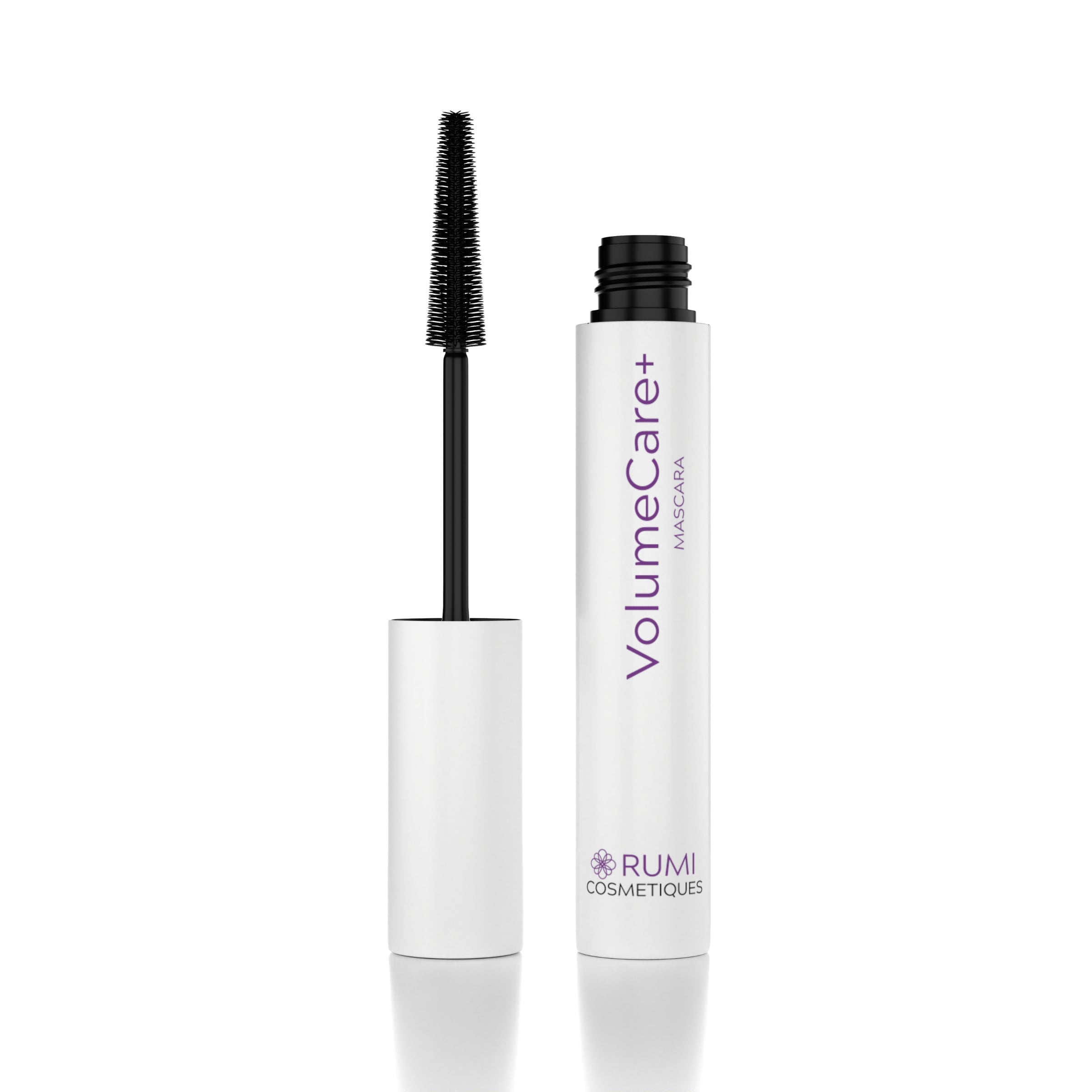
VolumeCare+ Mascara works differently. Instead of painting a coat of pigment onto each lash, it wraps it — forming a flexible polymer sleeve around every individual strand as it dries. I know that sounds a little technical, so let me break down what it actually means for the lash on your lid.

That last point — the removal — matters so much more than it might seem at first. A trichologist I spoke with made the point that repeated rubbing and tugging at the lash line during makeup removal can damage follicles over time.
For lashes that are already in a shortened growth cycle, that daily mechanical stress is genuinely the last thing they need. I hadn't even thought about removal as part of the problem until that conversation. It changed how I approached the whole thing.
"The removal isn't just a convenience feature. For mature lashes it's genuinely protective — because the lash you save today is the one you still have next month." 💕
And because the sleeve wraps each lash individually rather than fusing them together, it adds visible diameter, length at the tip, and — crucially — lift. ☀️

The Mascara Your Lashes Have Been Waiting For
I hope this has answered something that's been quietly bothering you for a while. I know it answered it for me. 💕
And I hear it from so many of you — women who are skilled, confident, and absolutely know their way around a makeup bag — suddenly feeling like something has shifted without quite knowing why.
Now you know why. And more importantly, you know it was never your fault.
| 1 | The Lash Triad — three simultaneous biological shifts that change the length, colour and angle of your lashes from your 40s onward, all at the same time. |
| 2 | The Lash Math — research shows a 20% drop in length and 28% drop in thickness between our twenties and sixties. Standard mascaras were never made for this! |
| 3 | LashSleeve Technology — a smarter way to coat, define and protect mature lashes, with warm water removal that eliminates the daily mechanical stress of scrubbing. |
VolumeCare+ Mascara was built around all three of these realities. Not as an afterthought, but designed specifically for the lashes you have right now, at this stage of life. 💕
That feels important to me. It's the whole reason we made it. 💕

"You deserve a mascara that was formulated for your lashes — not the ones you had twenty years ago."
If you've been quietly putting up with mascara that just doesn't seem to work the way it used to, I'd genuinely love for you to try this. 💕
I think you'll feel the difference from the very first application — and I think the removal moment will surprise you just as much as it surprised me.
TRY VOLUMECARE+ MATURE LASH MASCARA OR REORDER AGAIN SO YOU NEVER RUN OUT!
Designed for the lashes you have now — not the ones you had at 25.

As always, thank you for reading and for being part of this community.
Your messages, your questions, and your honesty about what you're experiencing are exactly what drives everything we do at Rumi Cosmetiques. Until next time!
With love, Kate x 💕
Sources
- Glaser DA, et al. "Eyelash Characteristics in Women." Dermatologic Surgery, 2014. PubMed ID 25347452. (Primary source for the 20% lash length drop and 28% thickness drop statistics.)
- Bayramlar H, et al. "Eyelash Disorders." PubMed ID 24448310. (Source for eyelash whitening prevalence: 0% of women under 40 vs. 14.7% of women aged 71–80.)
- Harvard Health. "Treating Female Pattern Hair Loss." Updated April 2024. health.harvard.edu. (Source for the two-thirds of postmenopausal women experiencing hair thinning statistic. Refers to scalp hair — framed in this article as the same follicle biology applying to lashes.)
- Holden K, trichologist. Quoted in HELLO! Magazine. (Source for the mechanical lash damage / removal-stress angle.)
- Medscape eMedicine, Article 1212294. "Dermatochalasis." (Source for eyelid laxity onset most frequently noted in the 40s — underpins Shift Three / lash ptosis.)
- Thibaut S, et al. "Human eyelash characterization." British Journal of Dermatology 162(2):304–310, 2010. DOI 10.1111/j.1365-2133.2009.09487.x. (Background reference on eyelash anagen cycle length and growth rate.)